Agents of Change: How AI is Reshaping MarTech Workflows
How to think about AI agents not as replacements, but as amplifiers that make your daily work smarter, faster, and more reliable.
By Anil Umachigi
#Part 1: What's Actually Happening
Over the past 18 months, "AI agents" have become the go-to topic in MarTech. New product launches showcase them, industry conferences explore their potential, and every major roadmap seems to include an agent strategy.
There's no denying the buzz — but beneath the excitement, a genuine shift in how marketing technology works is starting to unfold.
I recently spoke at MeasureCamp Sydney on October 25th with marketing practitioners about where AI agents actually fit into their workflows.
The conversation landed on something straightforward: the real value isn't in replacing people with agents. It's in giving people better tools to do their work.
Think of it as Amplified Intelligence — tools that make your existing workflows smarter. That reduce friction in your daily execution. That shift your time away from repetitive work and toward strategy.
#Part 2: The Foundation — Journey, Stack, and Data
To understand where agents fit, we need to start with the landscape you're already operating in.
Modern marketing works across a predictable customer lifecycle:
Awareness → Consideration → Purchase → Onboarding → Retention → Advocacy
Each phase has different goals, different tools, and different data flowing through.
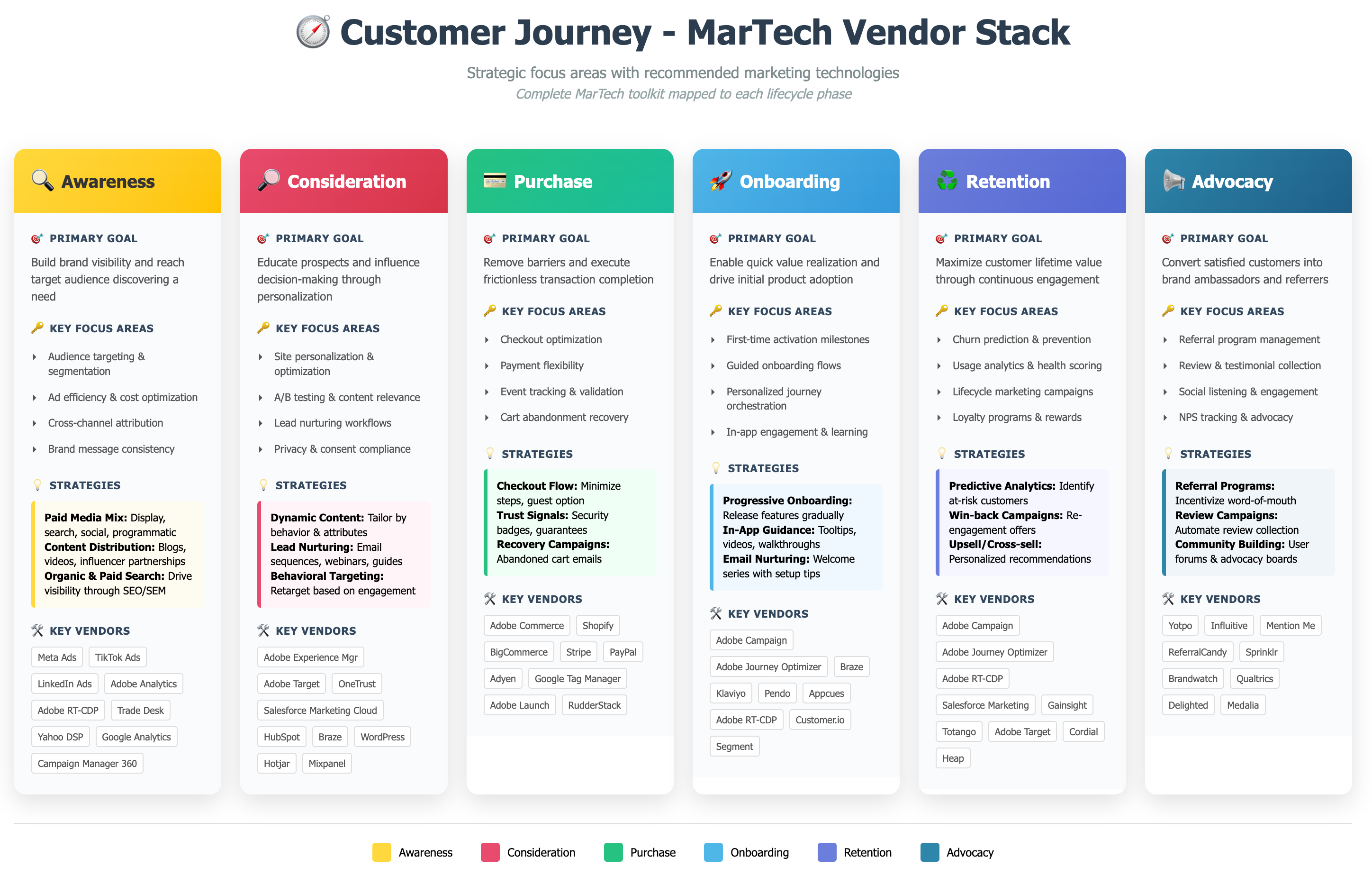
Now layer in the martech vendor landscape (not a comprehensive list).
If you've been in this world for more than five minutes, you know that no single platform owns the entire customer journey. Instead, practitioners orchestrate an ecosystem:
- Awareness: Meta Ads, TikTok, LinkedIn, Adobe RT-CDP, Google Analytics, programmatic DSPs, Adobe Advertising Cloud
- Consideration: Adobe Experience Manager, Salesforce Marketing Cloud, HubSpot, Braze, WordPress, Adobe Analytics
- Purchase: Shopify, Adobe Commerce, Google Tag Manager, Adobe Analytics
- Onboarding: Adobe Journey Optimizer, Braze, Pendo, Appcues, Segment
- Retention: Adobe Campaign, Salesforce, Gainsight, Totango, churn prediction tools
- Advocacy: Yotpo, Influitive, NPS platforms, social listening tools
This is where practitioners spend their days: configuring, integrating, and orchestrating these tools. Feeding them data. Extracting insights. Optimizing campaigns. Managing audiences. Ensuring compliance.
This fragmentation creates complexity. But it also creates an extraordinary data asset.
Every day, you're:
- Building and managing customer segments across multiple platforms
- Running hundreds of campaigns and journeys
- Testing, measuring, and optimizing experiences
- Collecting behavioral, transactional, and engagement data
- Managing compliance frameworks
- Documenting processes and governance
That's not just operational data. That's organizational knowledge — insights about what works, what doesn't, and why.
The vendors are now building agents on top of it.
But there's more. Outside your vendor platforms, you're also accumulating secondary data: documentation, process workflows, compliance rules, best practices, team structure, internal tools. Most of it trapped in spreadsheets and wikis.
This is where the real opportunity lives — in combining vendor agents (operating on their platform data) with custom agents you build (operating on your organizational knowledge).
#Part 3: Agents in Action — What's Shipping
Let's ground this in reality. What are vendors actually building?
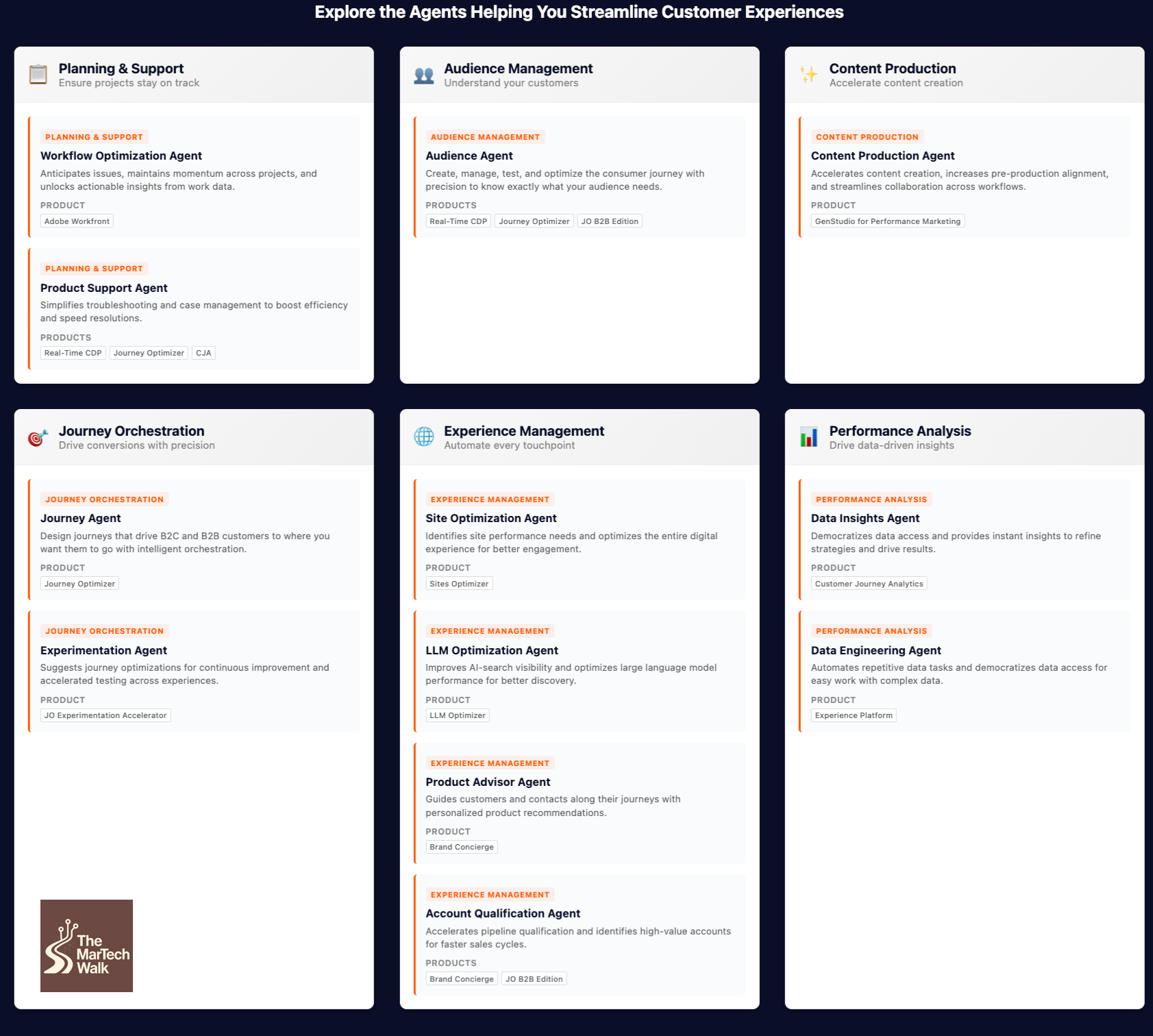
Adobe Experience Platform Agents is the most concrete example. Adobe looked at their platform — which houses customer journey data, audience information, campaign performance, and more — and built 11 specialized agents across 6 categories:
- Planning & Support
- Audience Management
- Content Production
- Journey Orchestration
- Experience Management
- Performance Analysis
But Adobe isn't alone. Across the vendor landscape, you're seeing:
- Braze: Dynamic content routing, send-time optimization, churn prediction, segmentation agents
- HubSpot: ChatSpot AI assistant, content generation, lead scoring, feedback collection
- Salesforce: Einstein Copilot, revenue forecasting, opportunity scoring
- Klaviyo: Flow automation, send-time optimization, product recommendations, cart recovery
- Amplitude: Behavior modeling, retention optimization, anomaly detection
- Segment/Twilio: Journey orchestration, CDP intelligence, audience activation, channel routing
#Part 4: Deep-Diving into Vendor Agents — The Adobe Example
Let's get specific about how these work, using Adobe as the case study.
Adobe Experience Platform Agent Orchestrator is the technology behind Adobe Experience Platform Agents. It powers the intelligence and reasoning behind these expert agents, enabling them to execute complex decision-making and problem-solving tasks at speed and scale.
#Part 5: The Workflows That Matter (And Where Agents Fit)
Now let's get tactical. Where do these agents actually work in your day-to-day operations?
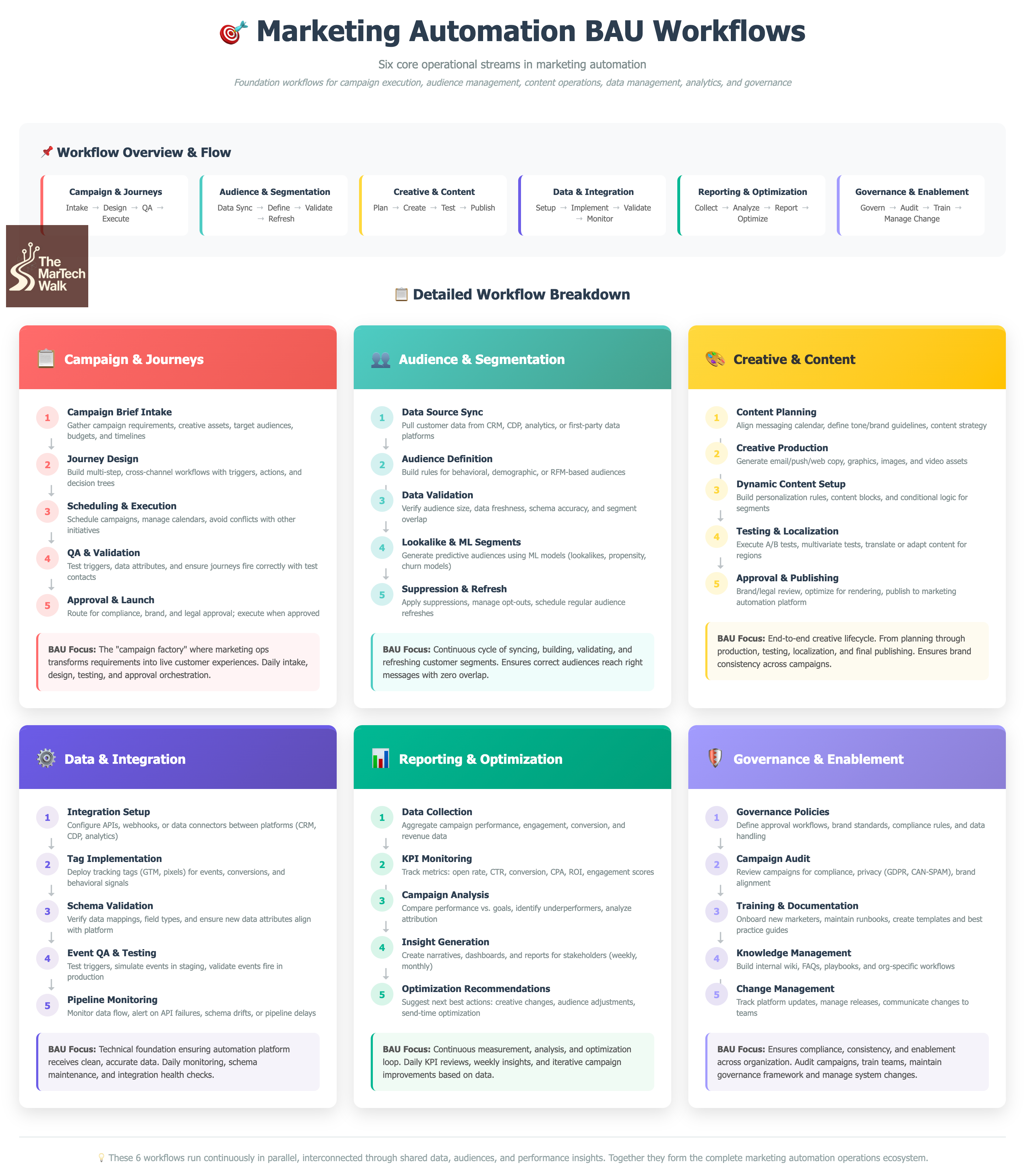
#Workflow 1: Marketing Automation Campaign Factory
Current state — 5 steps, mostly manual:
- Campaign brief intake
- Journey design
- Scheduling
- QA & validation
- Approval & launch
Where agents can help:
- Intake Agent: Automatically parse campaign briefs, extract key requirements, suggest audience segments
- Journey Design Agent: Generate journey templates based on campaign type and historical performance
- QA Agent: Automatically test journey logic, validate data mappings, flag common errors
- Approval Workflow Agent: Route for compliance review, track approval status, suggest optimizations
Impact: Instead of 2–3 hours of manual setup work, practitioners focus on creative strategy. The agent handles the operational lift.
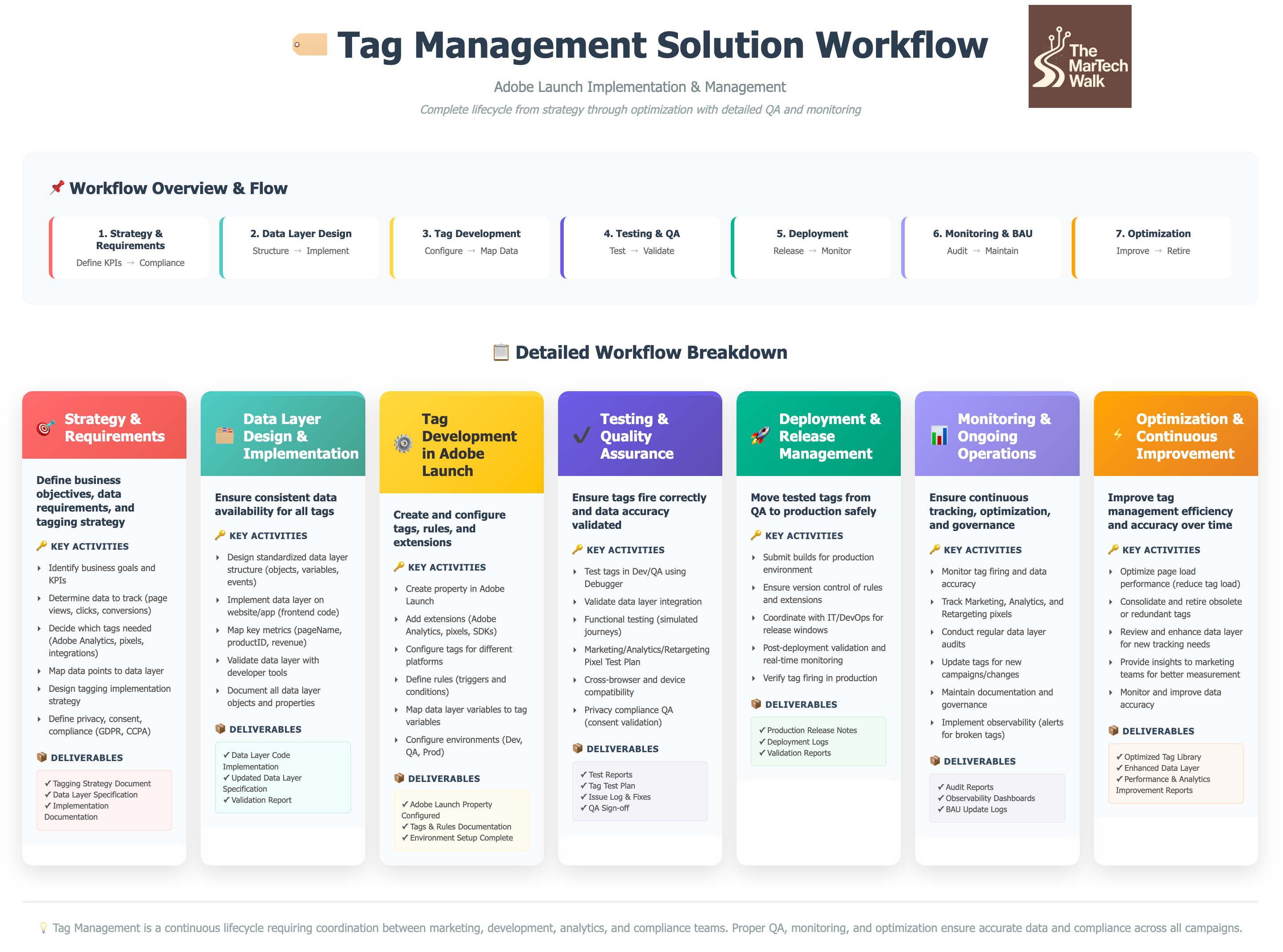
#Workflow 2: Tag Management & Data Layer
Current state — 7 steps:
- Strategy & requirements
- Data layer design
- Tag configuration
- Testing & QA
- Deployment
- Monitoring
- Optimization
Where agents can help:
- Tag Audit Agent: Continuously scan for broken tags, data layer mismatches, compliance violations
- Data Layer Agent: Monitor data quality, suggest new attributes needed for campaigns, validate schema consistency
- QA Agent: Automate testing of tags against checklist, simulate user journeys, validate event firing
- Compliance Agent: Ensure GDPR/CCPA/consent compliance, flag privacy issues, audit tracking implementations
Impact: Instead of manual audits and monthly compliance reviews, practitioners get continuous monitoring and early warnings.
#Part 6: The Evolving Landscape — Understanding Your Options
Here's what we're learning: this is early. The technology is moving fast. And we're still figuring out the optimal ways to apply agents to marketing workflows.
Right now, there are several paths emerging. Rather than prescribe a single approach, it's worth understanding the landscape and the trade-offs.
#In-Product Vendor Agents
These are the agents vendors are embedding directly into their platforms. They operate on the vendor's platform data, they're integrated into workflows you already know, and they come with vendor support.
The advantage is speed and integration. The limitation is scope — they can only work with data inside their platform and they're constrained by what the vendor chose to build.
#Custom Agents You Build
Custom agents operate on your organizational knowledge. Your documentation about what works. Your compliance rules. Your process workflows. Your best practices. They're built specifically for your context.
The advantage is flexibility and ownership. The limitation is it requires investment — both in building and maintaining them.
#Agentic Applications (The Emerging Middle Ground)
A new approach is emerging: agentic applications that integrate information from both vendor platforms and your internal systems. These aren't just standalone custom agents. They're orchestration layers that can:
- Pull data from multiple vendor platforms (your CDP, your marketing automation tool, your analytics platform)
- Access your internal documentation and knowledge bases
- Apply reasoning and decision-making across both sources
- Route information and workflows accordingly
Think of tools like Agent Composer, Model Context Protocol (MCP) standards that enable agents to access multiple systems, and A2A (Agent-to-Agent) communication patterns. These technologies are still being shaped, but they represent a potential future where agents operate across your entire martech ecosystem — not confined to a single platform.
#Recommended Approach: Explore and Learn
Start by understanding what's available in your current tools. Many practitioners don't realise their vendors already offer agent capabilities. Activate them. Use them. Get comfortable with how agents behave in your workflows.
Overlay these technologies against your workflows. Where is your team spending the most time? Where are the most errors? Where would acceleration have the most impact? Map agent capabilities against these pain points.
Run POCs (Proof of Concepts). Pick one workflow. Try an agent-assisted approach. Measure what changes: time saved, errors reduced, quality improved. Learn what works in your context.
Then expand. Based on what you learn from POCs, you'll have better data about whether vendor agents solve the problem, whether a custom agent is needed, or whether you need an integrated agentic application that spans multiple systems.
The technology is evolving quickly. The best approach right now is to stay curious, experiment, and build your organisational knowledge about how agents actually perform in your specific workflows.
#Part 7: Building Your Own Agents — The Practitioner's Toolkit
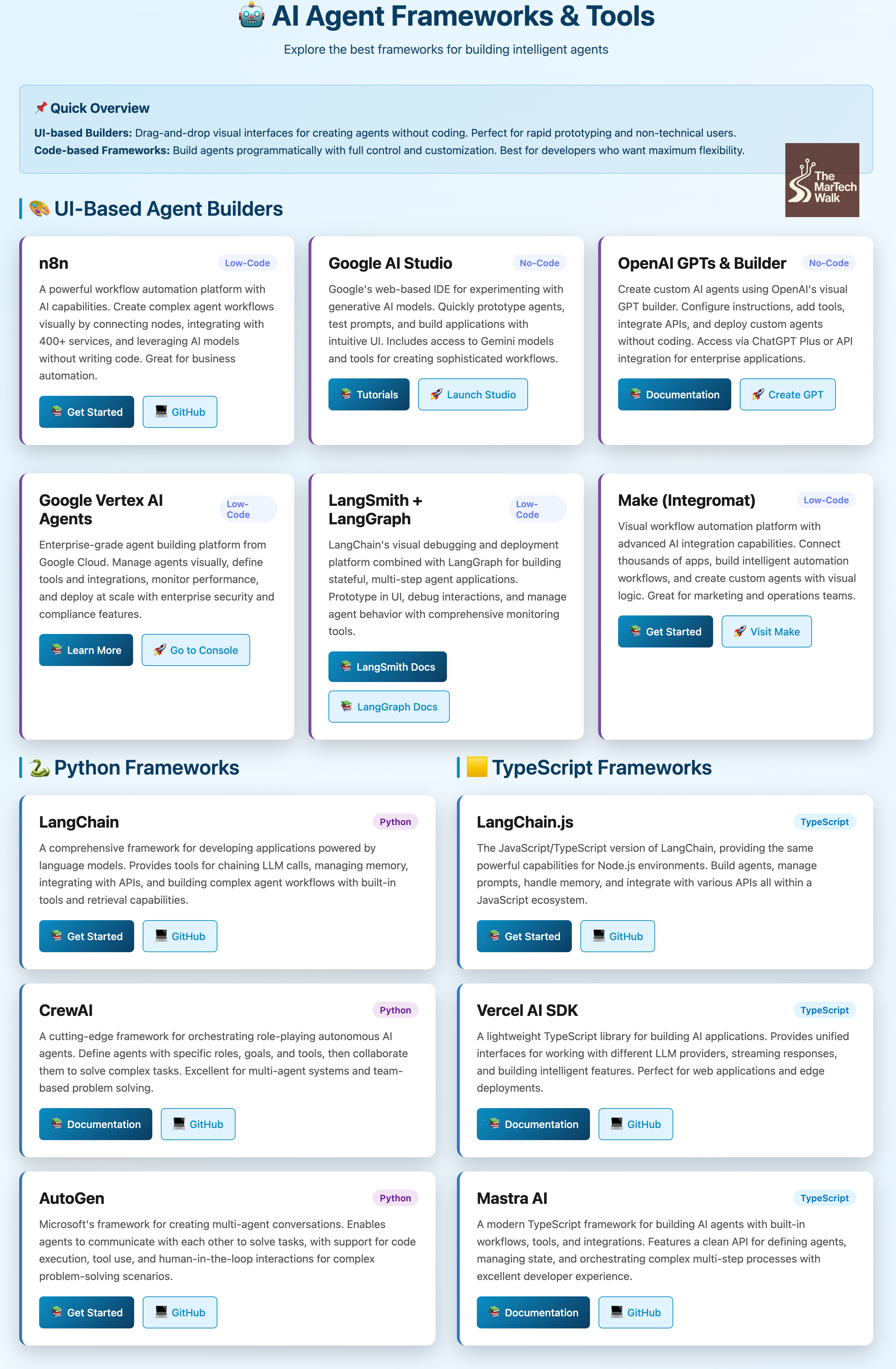
If you decide to explore custom agents, the landscape is worth understanding. As of October 2025, there are several frameworks and platforms available for building DIY agents — though this category is evolving rapidly.
The options today exist on a spectrum, from visual builders to code frameworks. What's available now is just the starting point.
#The Bottom Line
The AI agent story in MarTech isn't about magic. It's about leverage.
You're already:
- Configuring complex tech stacks
- Managing massive amounts of customer data
- Running sophisticated campaigns and journeys
- Following compliance frameworks
- Documenting processes and best practices
AI agents are tools that help you do all of this faster, with better consistency, and fewer manual errors.
The vendors are building agents on top of their data.
But you should be building agents on top of your organisational knowledge.
That's where the real transformation happens.
This post was inspired by my session at MeasureCamp Sydney on October 25, 2025.
Stay in the loop
Get new field notes in your inbox.
Practical guides on Adobe Experience Cloud, data collection, and modern marketing. No noise.
Unsubscribe whenever you like.
Read on
More to explore.

Data Products for Adobe Experience Cloud Users
What data products are, how to build them, and how Adobe Experience Cloud users can leverage them to accelerate insights and activation.
Start Here: Your Guide to The MarTech Walk
A guide to navigating The MarTech Walk and finding the content most relevant to you.